|
|
Chorale Melodies used in Bach's Vocal Works
Gelobet seist du, Jesu Christ |
|
Melody & Text | Use of the CM by Bach | Use of the CM by other composers |
| |
|
Melody & Text: Zahn: 1947 | EKG: 15 |
|
Melody: |
|
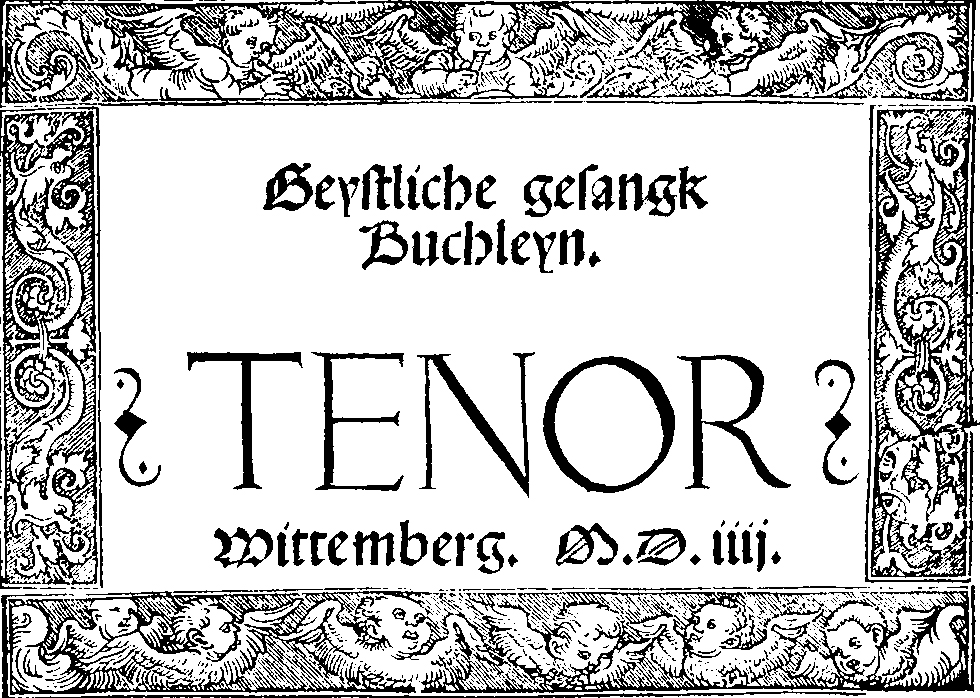
The earliest recorded instance of this melody appeared in print in Johann Walter’s collection of 3- to 5-part settings of chorale melodies entitled Geystliche gesangk Buchleyn.
This collection consists of a series of part books of which
the tenor part is the most important because it contains the main melody as well
as the complete text. Having the tenor part carry the melody was part of the
Tenor-Lied tradition that was current at that time. Martin Luther and Walter, very likely working collaboratively, may have adapted this melody from a Leise source that still may have existed at that time, or they may have based it on liturgical chants commonly used for Advent and Christmas in the Pre-Reformation period. Thus the original Leise, which was very likely derived from the same sources, might have been quite similar to the Luther/Walter CM even though the latter may not have been derived directly from the Leise. In other words, the basis for both the Leise melody and the CM supplied by Luther/Walter can be found in sources which preceded both of them. There is no way to prove that Luther/Walter obtained the CM directly from the musical form of the Leise; however, in any case this CM contains many elements, fragments of thematic material, which are not original with either Luther or Walter as composers, nor would they have been original in the Leise CM. |
|
Luther derived the text of the first verse from a Low German version of Notker’s Christmas sequence “Grates nunc omnes reddamus’. Luther translated the first verse into German and then extended the sequence by adding 6 verses of his own.
This chorale belongs to the type of ‘expansions’ of “Leisen’ and other German spiritual songs from the late Middle Ages. These include the following of which each one retains the text (often in translated form) of the first verse original to which other verses are then added: “Nun bitten wir den Heiligen Geist”, “Komm, Heiliger Geist, Herre Gott”, “Wir glauben all an einen Gott”, “Mitten wir im Leben sind”, “Gott der Vater wohn uns bei”, “Gott sei gelobet und gebenedeiet”, "Jesus Christus, unser Heiland, der von uns den Gotteszorn wandt” (the latter based on J. Hus’s sacred song).
According to the Order of Church Services used in Württemberg in 1536, the usual one or two Psalm chorales before the sermons on the special holidays/ feast days of Christmas could be replaced by a “Leise’ such as “Gelobet seist du, Jesu Christ.”
Robert L. Marshall and Robin A. Leaver co-authored an article in the Grove Music Online dictionary, Oxford University Press, 2005, acc. 12/22/05, which covers the subject of “Leisen” and the ‘refrains’ which include the “Kyrie eleison” and the “Alleluja”.
[The score sample given below and taken from a composition based upon “Gelobet seist du, Jesu Christ” by Lucas Osiander (1584) even uses an “Alleluja” to replace the almost exclusively used refrain “Kyrie eleison”.]
>>The early Christian church provided a number of opportunities for congregational participation. The Ambrosian hymns were originally intended to be sung by the congregation, and congregational refrains were added to a number of liturgical chants. From the 6th century liturgical singing became the preserve of the cantor and choir. But extra-liturgical songs in the vernacular continued to be written and sung at principal festivals, some saints’ days and, later, in connection with liturgical drama. Throughout the Middle Ages the refrain ‘Kyrieleison’ was sung as part of the litany as well as after the Latin strophes of such hymns as the Te Deum or after the individual verses of psalms. By the Carolingian period, the ‘Kyrieleison’ refrain was frequently extended with short vernacular phrases, and German translations of the Latin hymn strophes themselves began to appear. The oldest surviving example is an Old High German version of the Latin hymn Aurea luce, the so-called ‘Freisinger Petrus-hymnus’, in an early 9th-century neumed manuscript. Such vernacular hymnody was particularly strong in German-speaking regions. Between the 9th century and 1518 over 1400 German vernacular hymns are known to have been written. The hymn of Hussite Bohemia, the English medieval carol and the Italian lauda are comparable repertories of this period.
From the 12th century the principal forms of vernacular singing that developed into the Reformation chorale were German translations of Latin chant, the Leise (German spiritual song) and the cantio (Latin spiritual song). Of all the forms of Gregorian chant, medieval translators understandably favoured the Ambrosian hymn of the monastic Offices with its short strophes, concise and straightforward language and essentially syllabic melodic style. These qualities later made it the most significant Gregorian source for the Protestant chorale writers. Single hymns such as the ‘Petrus-hymnus’ and even entire hymnaries were translated; but during the later Middle Ages hymns for the principal feasts were strongly preferred. Two of the most important German translators of the period, the Monk of Salzburg and Heinrich Laufenberg, set important precedents for Reformation poets with their choice of hymns as well as their translations. Late medieval hymn translations were rarely provided with musical notation, but the fact that they kept the original metrical schemes suggests that they were meant to be sung to the original melodies; the presence of rubrics suggests that they may have been used occasionally in some forms of liturgical worship.
Apart from the hymns, the chants for the Office did not as a group stimulate many translations, but individual antiphons such as Media vita in morte sumus, formerly attributed to Notker Balbulus, and the 11th-century Pentecost antiphon Veni Sancte Spiritus existed in the German versions Mitten wir im Leben sind and Komm, heiliger Geist, Herr Gott from at least the early 15th century. The chants for the Mass having non-strophic texts and relatively intricate melodies did not encourage translation in the pre-Reformation period, particularly since they remained the exclusive province of the clergy and choir. There were isolated translations of some items, however, such as a 15th-century German metrical rendering of the Credo, Wir glauben in einen Gott, which served as one of several sources for Luther’s Wir glauben all an einen Gott. Of the Propers only the sequence assumed considerable, indeed outstanding, importance for the later history of the chorale as the origin of the Leise.
During the late Middle Ages the practice developed of occasionally permitting the congregation to sing German versions of the sequence (itself by this time a metrical, strophic form) during the regular service at the principal feasts of the church year, immediately after the clergy and choir had performed the Latin original. These German strophes typically concluded with the refrain ‘Kyrieleis’ and thus suggested the name Leise for the genre, a name which was soon applied to other refrain songs as well. Most Leisen have a single strophe of four short lines, a simple melody often consisting of repeated motivic formulae and the ‘Kyrieleis’ refrain. Generally a Leise strophe retained the same melody throughout the centuries while the refrain continually received new settings, invariably of the simplest melodic material.
Since the Leise shares stylistic liturgical elements with the litany, the Kyrie, the hymn, the sequence and the folksong, its origins and development have been a matter of controversy. The picture is complicated by the fact that whereas there was an outburst of production of Leise texts between the 12th century and the early 14th, melodies for them are extant only from the 15th century. The most important and well-known Leisen, those which survive in Protestant chorales, have particularly strong musical and even liturgical connections with the sequence. The chorales
are associated with the major feasts, the opening strophes of which existed as Leisen in the Middle
Ages and all of which substantially derive their melodic material from the Latin sequence for the same feast.
Most of these Leisen appear with the corresponding Latin sequence in medieval liturgical manuscripts, and because of that they are now thought to have developed as abbreviated forms of the Latin sequence. According to this interpretation the concluding ‘Kyrieleis’ refrain, with its variable melodies, assumes only secondary importance, whereas earlier views suggested that the four-line strophe was appended to the original acclamation.
The Sequence [in this instance is]: “Gratis nunc omnes reddamus”
The Leise [is]: “Gelobet seist du, Jesu Christ”<<
|
|
The oldest known chorale text which Luther used as the first verse of his expanded version of this chorale has been traced back to 1380 (Hs. Bistumsarchiv Trier Nr. 529 {circa 1380 or even as late as the end of the 15th century, possibly originating in the Medingen Monastery near Lüneburg}; another source is the Wolfenbüttel Cod. Guelf 300.1 Extrav. from North Germany circa 1465). Here is the oldest extant text with a restatement including some other later variants of this Leise:
LOUET sistu jhu crist,
dat du hude bore bist
va eyner maghet dat is war,
dat vrowet sik alle heelsche schar.
Restatement:
(GHE)LOUET sistu jh(es)u c(h)rist,
dat du hude bore(n) bist
va(n) eyner maghet dat is war,
dat vrowet sik alle he(m)elsche schar.
(Kyrieleis).
In modern German:
Gelobet seist du, Jesu Christ,
daß du heute geboren bist
von einer Magd, das ist wahr,
dessen freuen sich alle himmlischen Scharen.
Kyrie eleison.
In English:
Let us praise you, Jesus Christ,
that you were born today
by a virgin, that is [certainly] true,
this is why all the heavenly hosts are happy.
Lord, have mercy upon us.
The period from 1523 to1524 represents Luther’s first phase dedicated to the creation of chorales (text and melody). This is the time when Luther wrote, modified or translated the chorale texts and composed the melodies or adapted and modified already existing musical materials. More than half of the hymns (the total number is 36) attributed to Luther, there were two dozen completed at this time, were created during this period. When this chorale appeared in print in 1524, it, as well as many others, certainly must have first appeared as broadsheets before they were incorporated in the first collections of chorales, specifically in Johann Walter’s choir hymnal and the Erfurt Enchiridien. If we can suspect that Luther completed these chorales at the same time when he prepared sermons based specifically on certain points of the liturgical year, then it is quite possible that this chorale was written out, printed out on a broadsheet and distributed in time for one of his sermons during Advent or Christmas of 1523 under the title Ain Deütsch hymnus oder lobsang auff Weyhenacht. [The Handbuch zum Evangelischen Gesangbuch, Göttingen, 2004, does not recognize the latter broadsheet as containing the melody of this chorale, but only the text as given there. Likewise, the collection entitled Eyn Enchiridion oder Handbüchlein and Enchiridion Oder eyn Handbuchlein (both Erfurt editions) contains only the text, but not the melody for this chorale.]
Attempting to document which precisely is the earliest extant version of Luther’s chorale, Gelobet seist du, Jesu Christ, is a task that is made very difficult by virtue of a number of circumstances:
1. There were numerous hymnals and chorale collections with different purposes in mind:
a. for use by a church choir only (3-, 4- or 5-part settings with the melody in the tenor part)
b. for use as a hymnal in church or at home (for a single voice only or only text)
c. for use by a church choir (4- or 5-part settings with the melody at the top in the soprano part) and/or
congregational
singing (melody more easily found located at the top in the soprano part)
2. These hymnals, choir books and broadsheets appeared in print rather frequently, often on an almost annual basis. Luther added and removed chorales from one edition to the next as he decided which ones to keep, which to add and which to remove.
3. Luther’s hymnals were often printed listing Wittenberg as the place of publication, but actually appeared in other cities throughout Germany (Erfurt, Nürnberg, Worms, Straßburg, etc.).
4. The date of publication indicated is wrong (printer’s error? or attempting to avoid the issue of plagiarism?)
An example of the latter is found on the title page of what appears to be Johann Walter’s tenor part book entitled: Geystliche gesangk Buchleyn. Although “Wittemberg” appears as the place of publication, the name of the printer/publisher is missing and the date given in Roman numerals is obviously in error: MD iiij = 1504. Only a musicologist or historian familiar with other editions carrying this title could begin to venture a guess that the Roman numeral Xs were left out and that this edition when placed into Luther’s biography could not be before 1524 but might also include dates like 1534, 1544, etc. The name of the city where this hymnal was published could be any of those listed above or even others not mentioned there. [The ‘pirating’ of Luther’s intellectual efforts is a problem he faced throughout this life. Printed versions of his translation of the Bible into German appeared without his permission or control in other parts of Germany.] It should also be noted here that Walter’s collection features very prominently the designation, TENOR, placing it within the Tenor-Lied tradition where the melody is always featured in the tenor part. From this it can be implied that other voices ‘accompanied’ the main chorale melody. This is indeed the case, for beginning with the 1524 edition of Walter’s Geystliche gesangk Buchleyn, and all its subsequent editions, there were always other part books in the set so that other choir members could sing along in harmony with the CM using the 3- to 5-part settings that Walter had supplied.
Here is such a title page which can also be viewed on-line at the site of the Bayrische Staatsbibliothek: |
|

|
|
Source: http://daten.digitale-sammlungen.de/~db/0002/bsb00027050/images/index.html?id=00027050&fip=59.154.42.141&no=52&seite=54 |
|
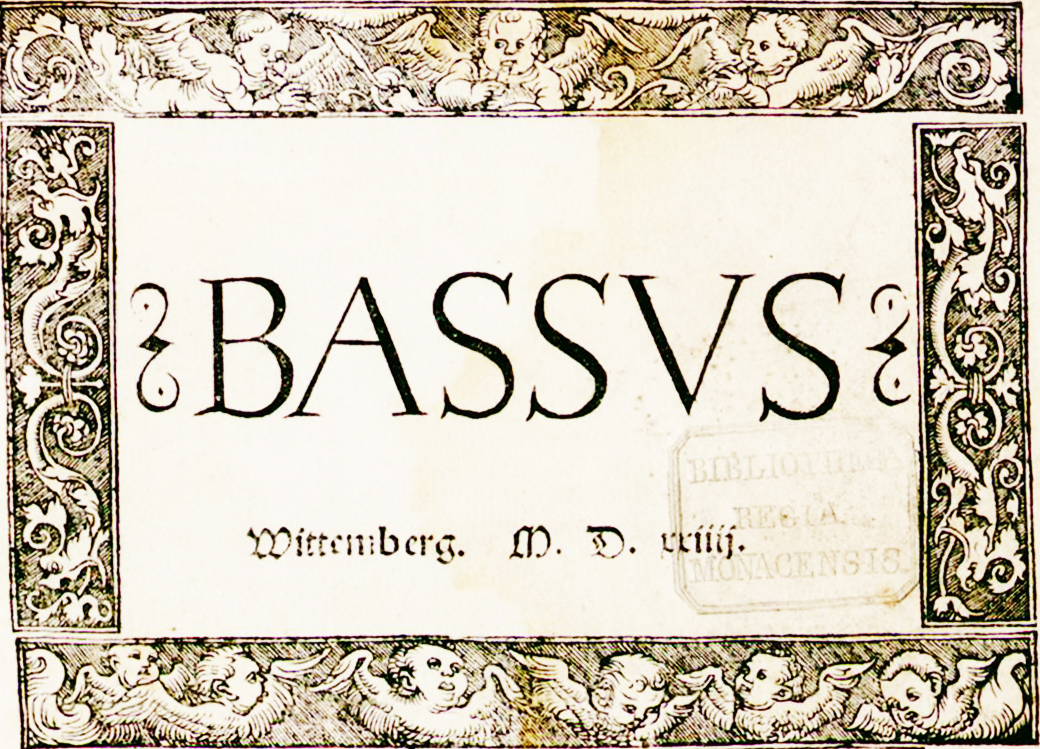
Displayed below is the title page from Walter's bass part
book where only the first verse is included under the notes. Note that the date
is now given as 1524: |
 |
|
Source: http://daten.digitale-sammlungen.de/~db/0002/bsb00027052/images/index.html |
|
For comparison, here is the title page as printed by Peter Schöffer in Worms in 1525. Note that the orthography of the title of the book has changed, possibly because it appeared in a different part of Germany. Schöffer does note correctly that this book first appeared in ‘Wittenberg’, not spelled ‘Wittem’ as in the above version. |
|

|
|
Source: MGG1 |
|
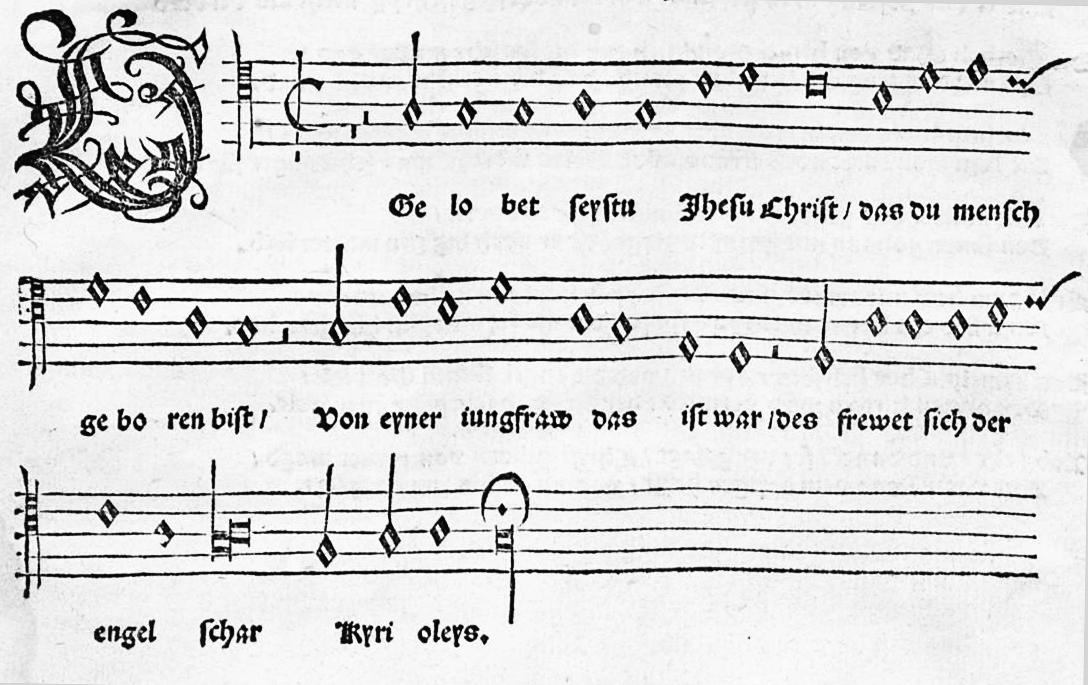
In the first facsimile from the Bayrische Staatsbibliothek, the chorale is listed as No. 22 with the following text:
XXII
Gelobet seystu Jhesu Christ / das du mensch geboren bist /
Von eyner iunfraw das ist war / des frewet sich der engel schar /
Kyrioleys
.
Des ewigen Vaters eynig kind / itz man ynn der krippen find /
Inn vnser armes fleysch vnd blut / verkleydet sich das ewig gut / Kyrioleys.
Den aller welt kreys nie beschlos / der ligt ynn Maria schos /
Er ist eyn kindlin worden kleyn / der alle ding erhelt alleyn / Kyrioleys.
Das ewig liecht geht da hereyn / gibt der welt eyn newen scheyn /
Es leucht wol mitten ynn der nacht / vnd vns des liechtes kinder macht / Kyrioleys.
Der son des vaters Gott von ard / eyn gast ynn der werlet ward /
Vnd furt vns aus dem iamer tal / er macht vns erben ynn seym saal / Kyrioleys.
Er ist auff erden kommen arm / das er vnser sich erbarm /
Vnd ynn dem hymel machet reych / vnd seynen lieben engeln gleich / Kyrioleys.
Das hat er alles vns gethan / seyn gros lieb zu zeygen an /
Des frew sich alle Christenheyt / vnd danck yhm des ynn ewickeyt / Kyrioleys.
In English this is:
Let us praise you, Jesus Christ, for the fact that you have been born as a human being
by a virgin, this is true, and, for this reason, the host of angels are happy. Lord, have mercy on us.
The only child of the eternal Father you can now find in the crib,
This eternal goodness (aeternum bonum=the spiritual gift of grace which brings about eternal salvation) clothed in the [same] poor flesh
and blood as we. Lord, have mercy on us.
He, whom the entire world (orbis=everything the world encompasses) could not contain, lies in Mary’s lap.
He has become a little child who alone sustains (saves, protects) everything. Lord, have mercy on us.
The eternal light goes into all these things and gives the world a new [glowing] appearance.
It even shines in the middle of the night and makes us become children of the light. Lord, have mercy on us.
The Son of God the Father by birth became a guest in the [this] world
and leads us out of this valley of misery [vale of tears] and makes us his heirs in his [reception] hall. Lord, have mercy on us.
He has come to this earth poor so that he can have mercy on us
And in heaven he makes [us] rich so that we can be like his dear angels. Lord, have mercy on us.
All this he has done for us to show us his great love.
For this reason let all Christianity be glad and thank him for this through all eternity. Lord, have mercy on us.
It would appear that the facsimile from the Bayrische Staatsbibliothek, taking into account all of the difficulties already mentioned, might be the earliest representation of Luther’s chorale as it gives the full text of chorale [the first verse is Luther’s ‘translation’ of the Leise from Low German into a form of German more easily understood over a wider area of Germany] as well as the melody which Luther may have adopted from no longer extant Leise sources with only a few changes or which he may possibly have modified considerably. In any case it is possible to establish the connections between the melodic patterns (certain thematic fragments) of the Alleluja and Sequence used in the mass for the first week of Advent before the Reformation and the chorale melody used by Luther. It is just as likely that the Leise melody for LOUET sistu jhu crist cited above was already in existence and resembled with probably only a few minor alterations by Luther and/or Walter the melody which is presented
here as it appears in the tenor part of the Geystliche
gesangk Buchleyn: |
|

|
|
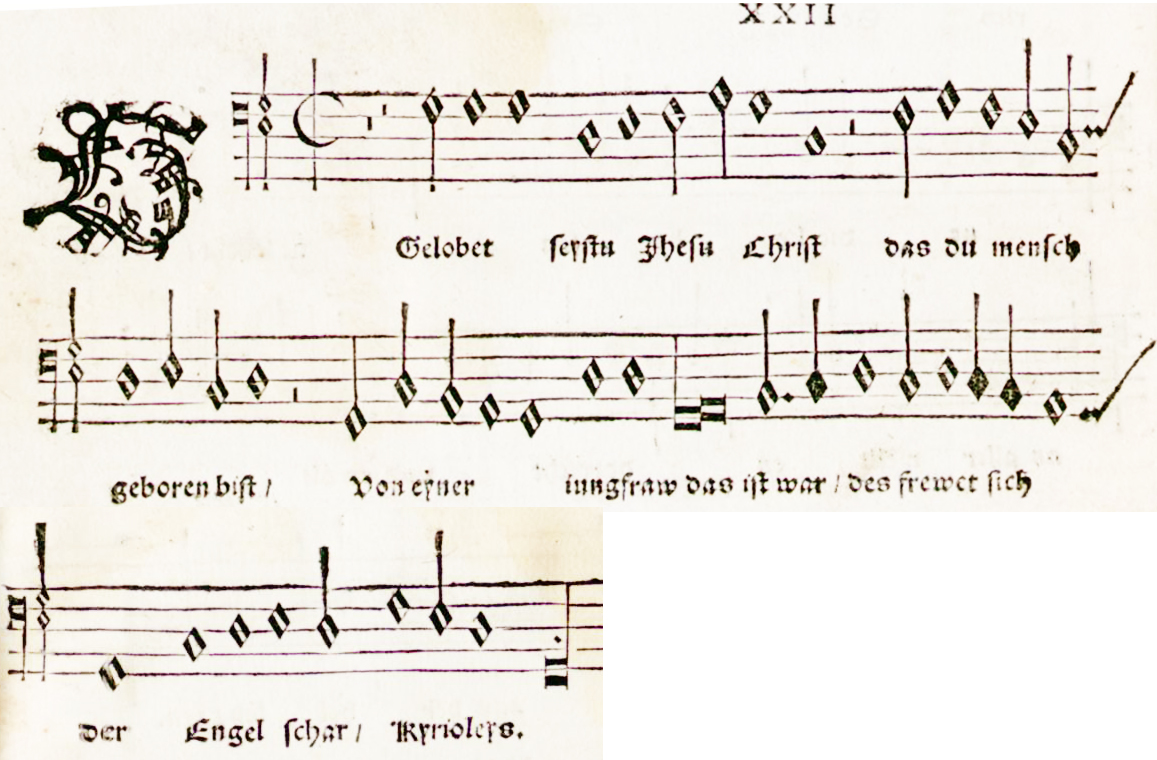
The bass part for this chorale appears in a separate volume
with only the first verse of the CM and looks like this: |
 |
|
Today the origins of the melody of the Leise on which this chorale is based can still be reconstructed by comparing the melody sources which Luther may have used with the final 1524 (Walter) printed version of Luther’s chorale melody with its text. Walter may even have collaborated with Luther in creating the final version, or better yet, the adaptation of the Leise melody. There is even a chronological development that can plausibly be established beginning with the Alleluja from the Mass for the first Sunday in Advent [derived from the Graduale Triplex, although only existing from a later date, it nevertheless represents what was commonly used in the churches in the decades and centuries preceding the Reformation – this is the top staff in the example below with the diagonal slashes indicating omissions], then continuing later with the melody of the sequence documented at a later date from the Graduale pataviense (Vienna, 1511) [this is the middle staff with the Latin text Grates nunc omnes reddamus], and concluding with the putative Leise melody indicated on the lower staff: |
|

|
|
Source: Handbuch zum Evangelischen Gesangbuch, Band 3: Liederkunde zum Evangelischen Gesangbuch, Heft 10, Göttingen, 2004, p. 19. |
| |
|
Original Melody Sources: |
|
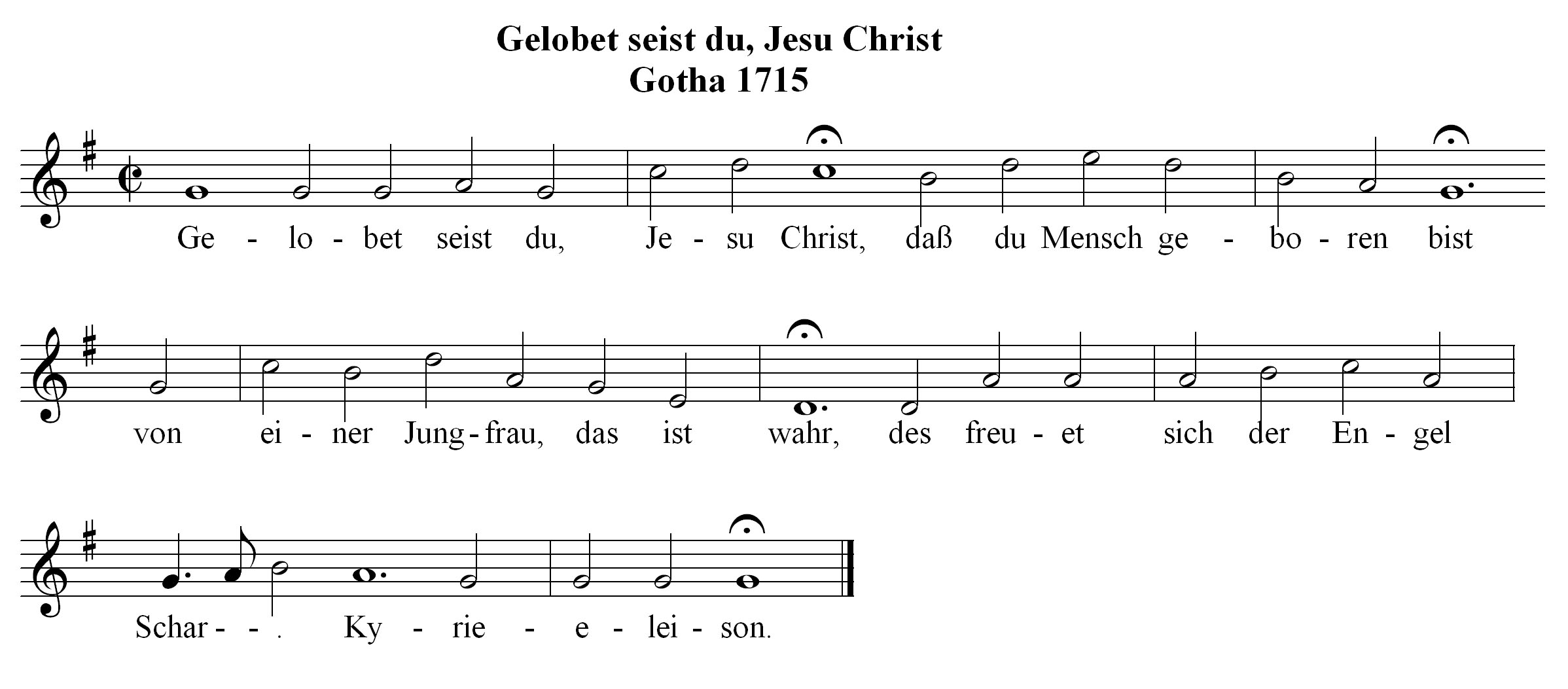
The melody found in the Gotha (1715) hymnal which Bach may have used appears as follows: |
|

|
|
Yet earlier uses of this melody with examples from hymnals or settings by earlier composers include the following:
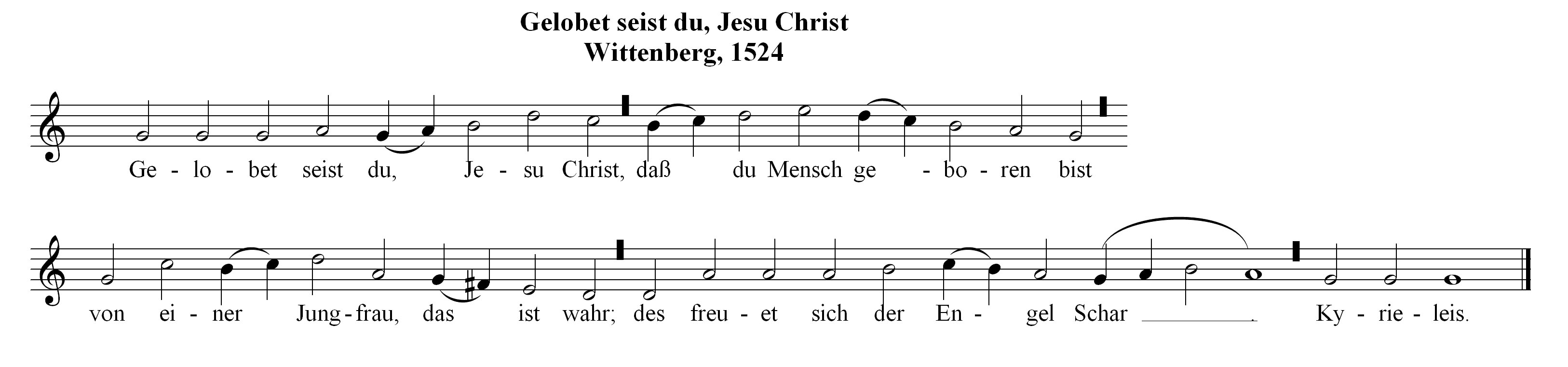
1. The earliest documented version of this CM, already presented in the Walter facsimile above, is here given in modern notation:” |
|

|
|
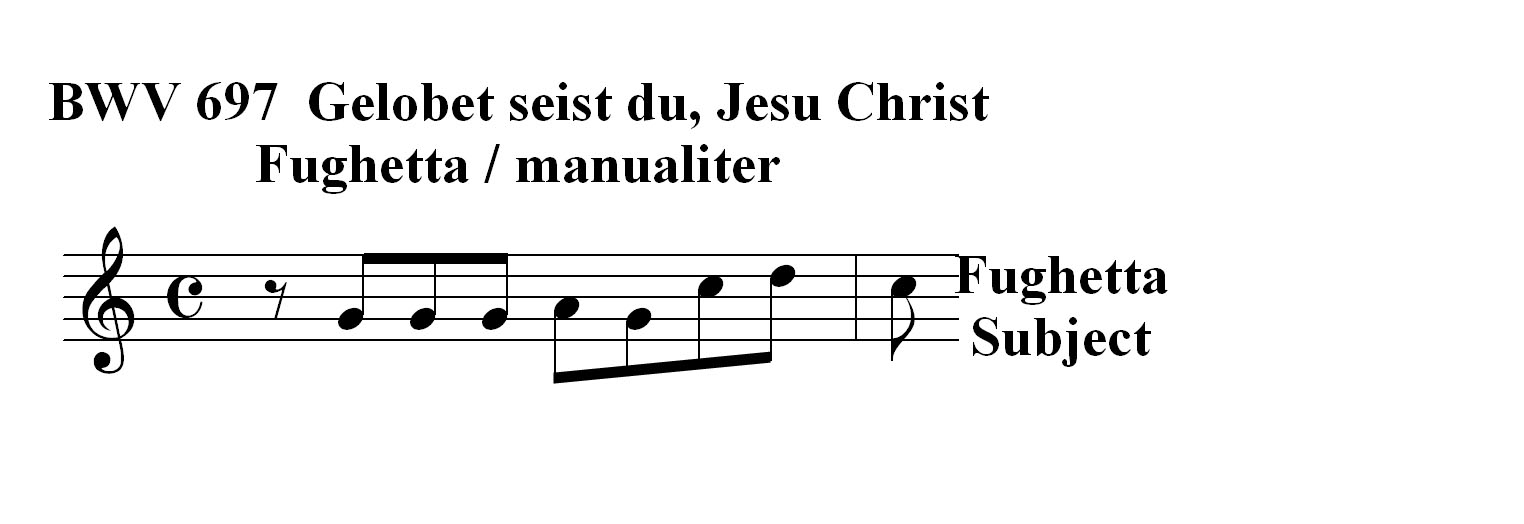
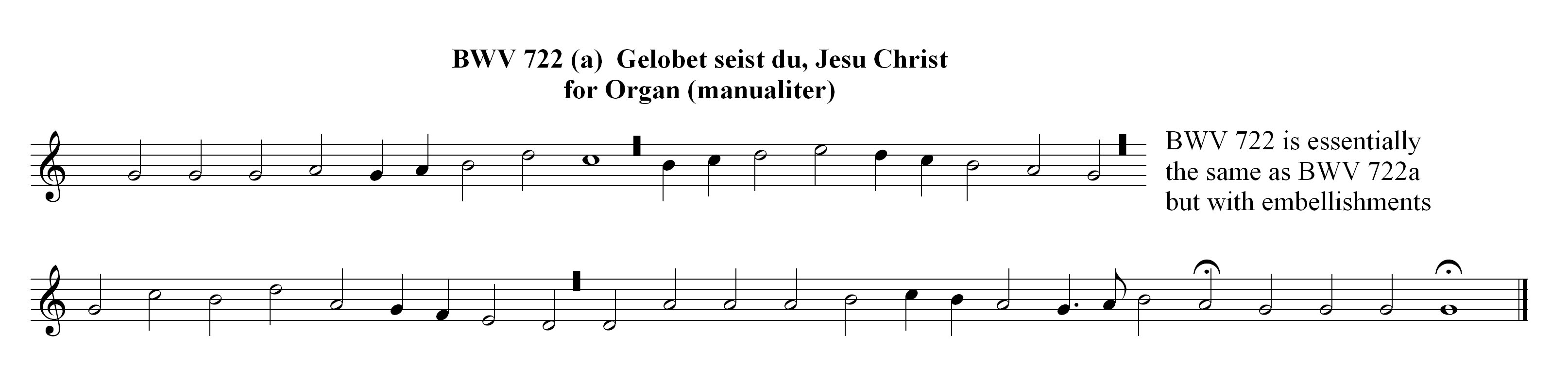
Note: Bach uses this variant of the chorale melody for BWV 722a and BWV 722, but not, interestingly enough for BWV 697, which has the more common used form of the melody. The NBA gives this variant melody (for BWV 722) as originating from Wittenberg, 1524, where it is known there as the "Grates nunc"). The text, of course, is still the same one, "Gelobet seist du, Jesu Christ" by Maartin Luther, first documented from 1524. |
|
Other earlier settings based on this melody and for which score samples can be viewed are: |
|
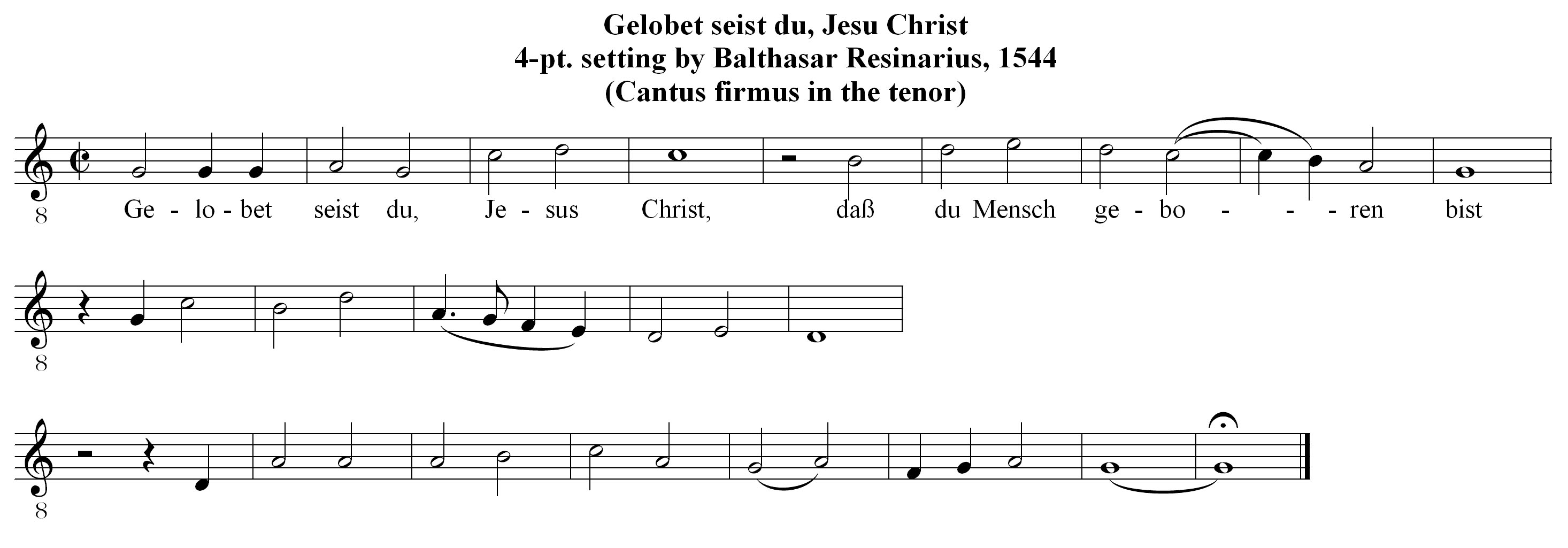
2. A 4-pt., chorale motet setting by Balthasar Resinarius (circa 1480-1546) with the cantus firmus in the tenor voice; first date of printing is 1544: |
|

|
|
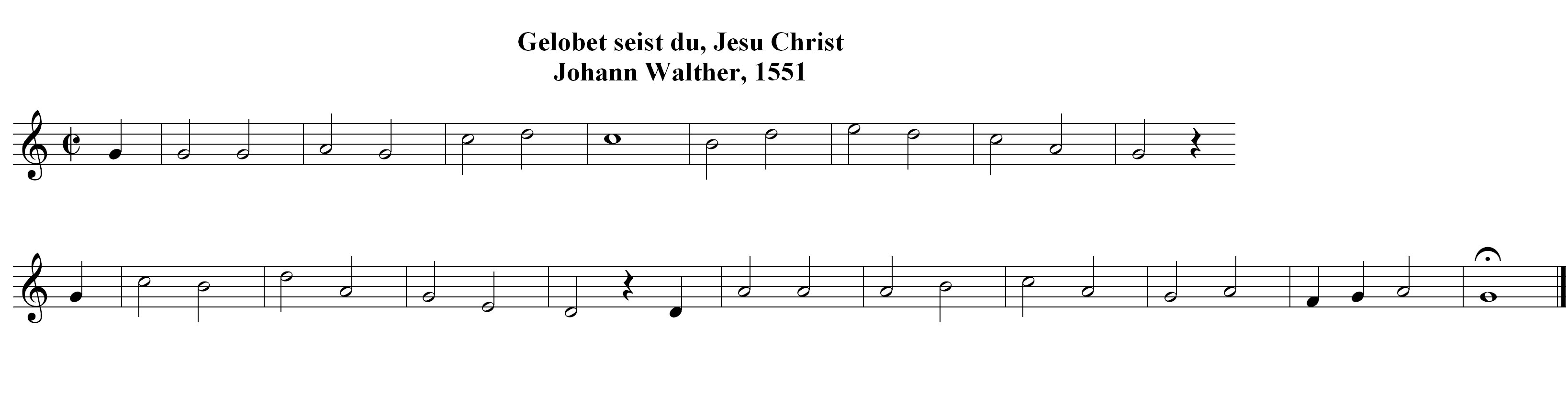
3. A 4-pt. chorale motet setting by Johann Walter (Walther) (1496-1570) dating from 1551 with the soprano voice having the cantus firmus: |
|

|
|
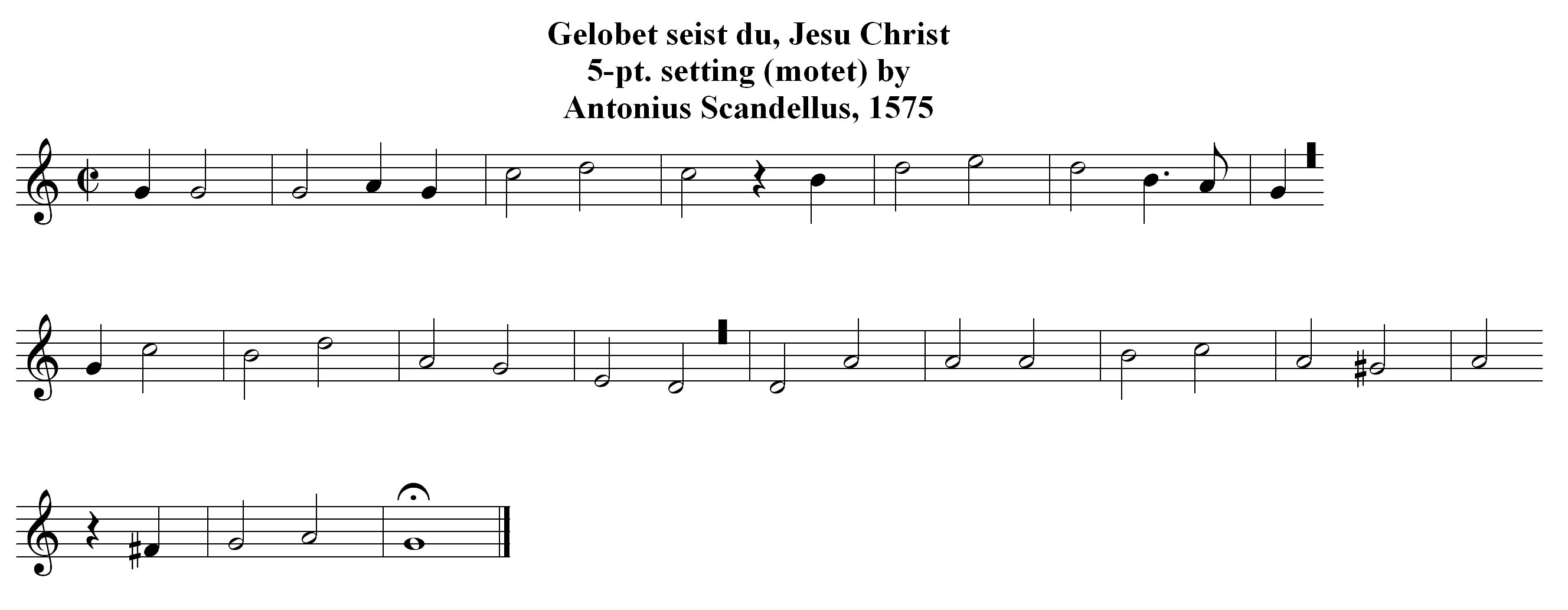
4. A 5-pt. chorale motet setting by Antonius Scandellus (1517-1580) from 1575 [the melody indicated in the score sample is assembled from the appearance of the cantus firmus in various voices]: |
|

|
|
5. A simple, straight-forward 4-pt. setting (stylo simplici) (or ‘stilo semplice’) by Lucas Osiander (1534-1604) from 1586: |
|

|
|
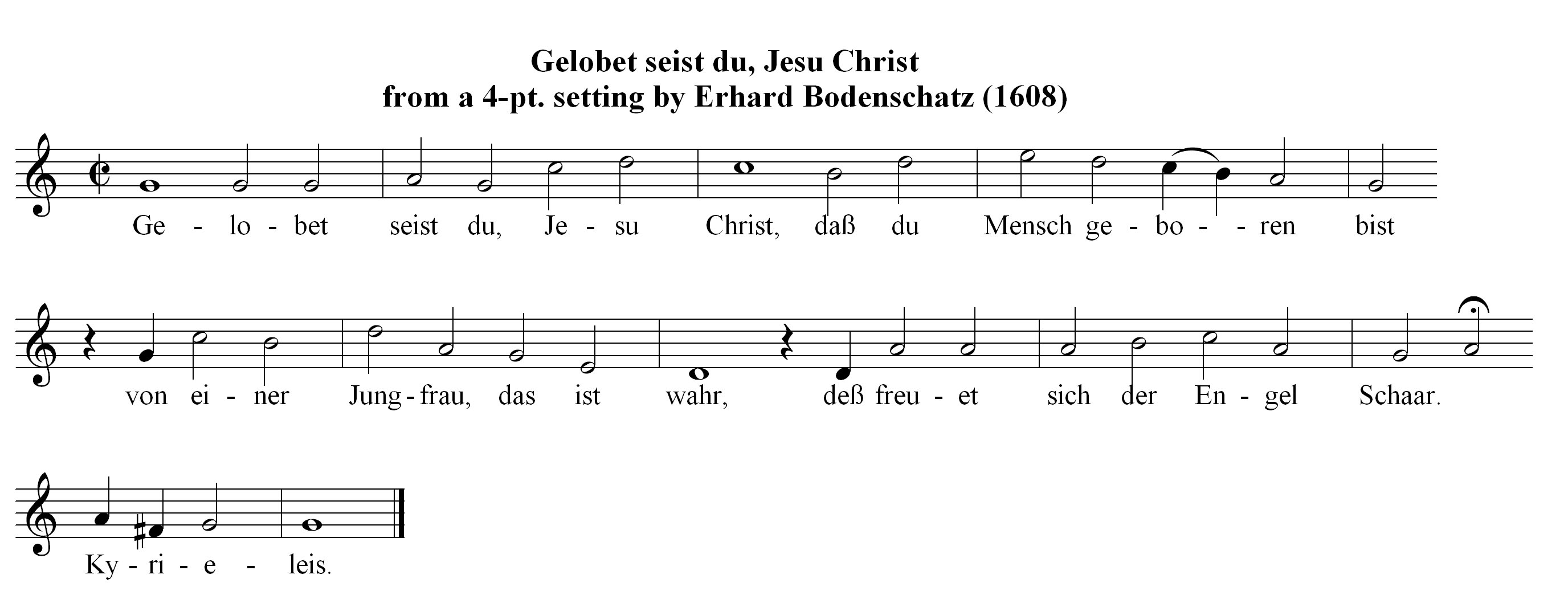
6. Another stylo simplici, 4-pt. setting by Erhard Bodenschatz (circa 1576-1636) dates from 1608: |
|

|
|
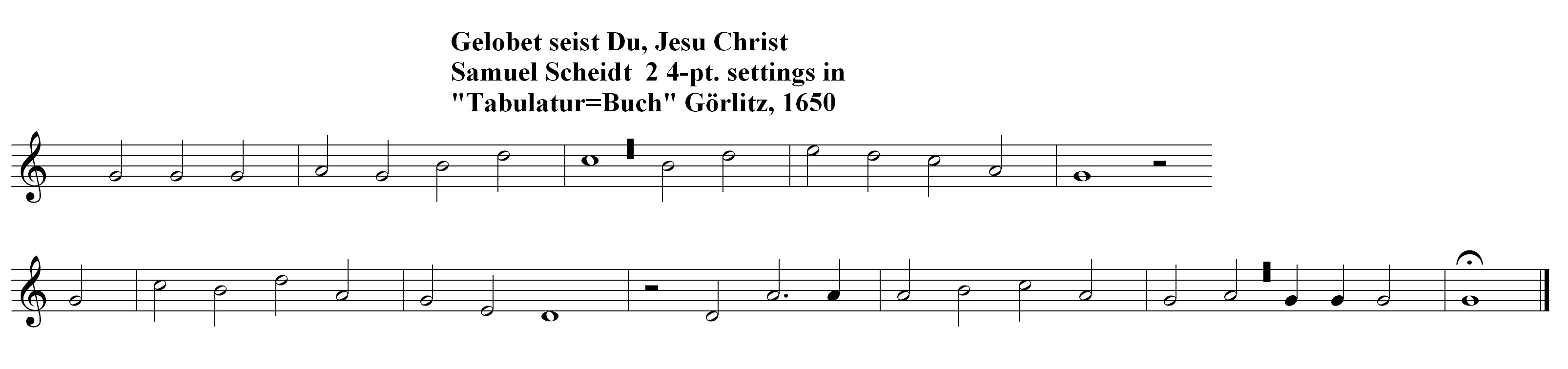
7. Samuel Scheidt (1587-1654) has two stylo simplici, 4-pt. settings [both with exactly the same melody as given in the score sample] dating from 1650 [see further details below] |
|

|
|
[Other pre-Bach compositions using this melody are listed below under Other Composers] |
| |
|
Use of the Chorale Melody by Bach: |
|
Text: Gelobet seist du, Jesu Christ | EKG: 15
Author: Martin Luther (Wittenberg, 1524) |
|
Ver |
Work |
Mvt. |
Year |
Br |
RE |
KE |
Di |
BC |
Score |
Music Examples |
|
7 |
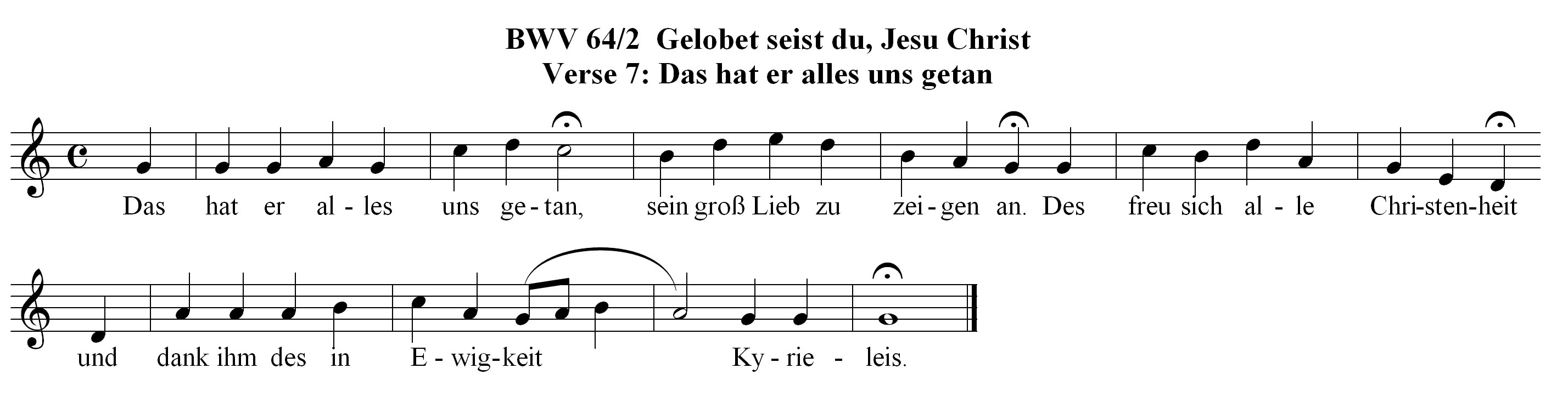
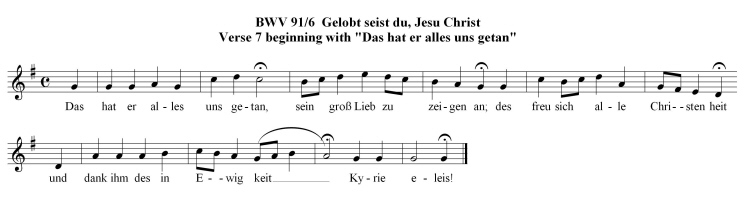
BWV 64 |
Mvt. 2 |
1723 |
160 |
108 |
160 |
13 |
:2 |
PDF |
Mvt. 2 (MG) [midi] | Mvt. 2 (Leusink) [ram] |
|
1 |
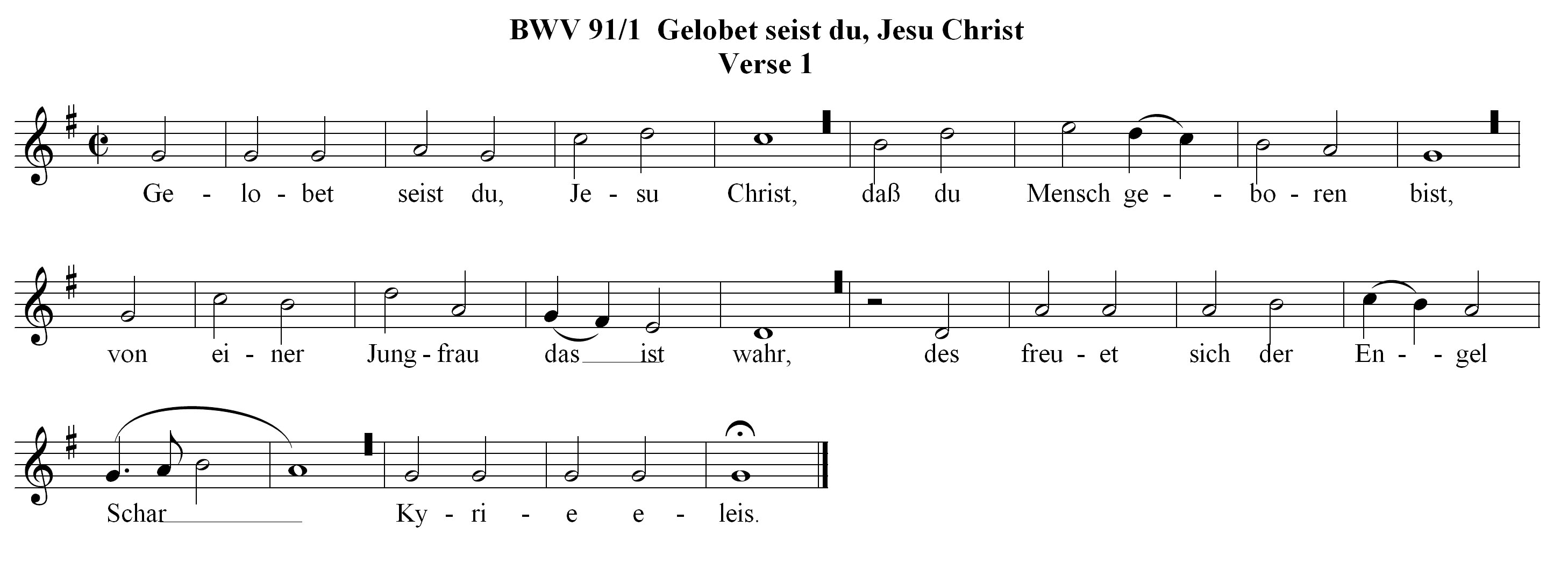
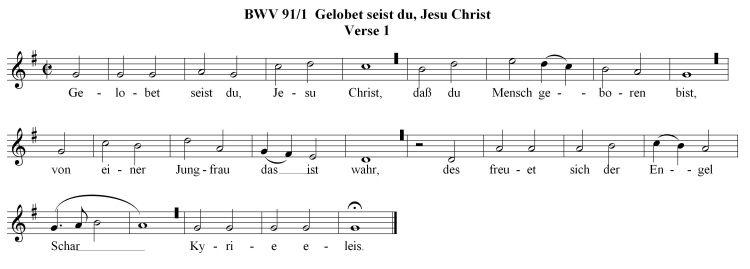
BWV 91 |
Mvt. 1 |
1724 |
- |
- |
- |
- |
A9:1 |
|
Mvt. 1 (Leusink) [ram] |
|
2 |
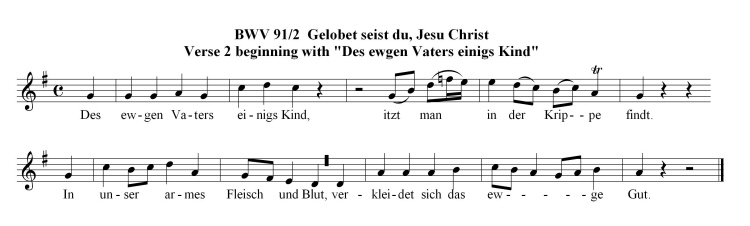
BWV 91 |
Mvt. 2 |
1724 |
- |
- |
- |
- |
A9:2 |
|
Mvt. 2 (Leusink) [ram] |
|
7 |
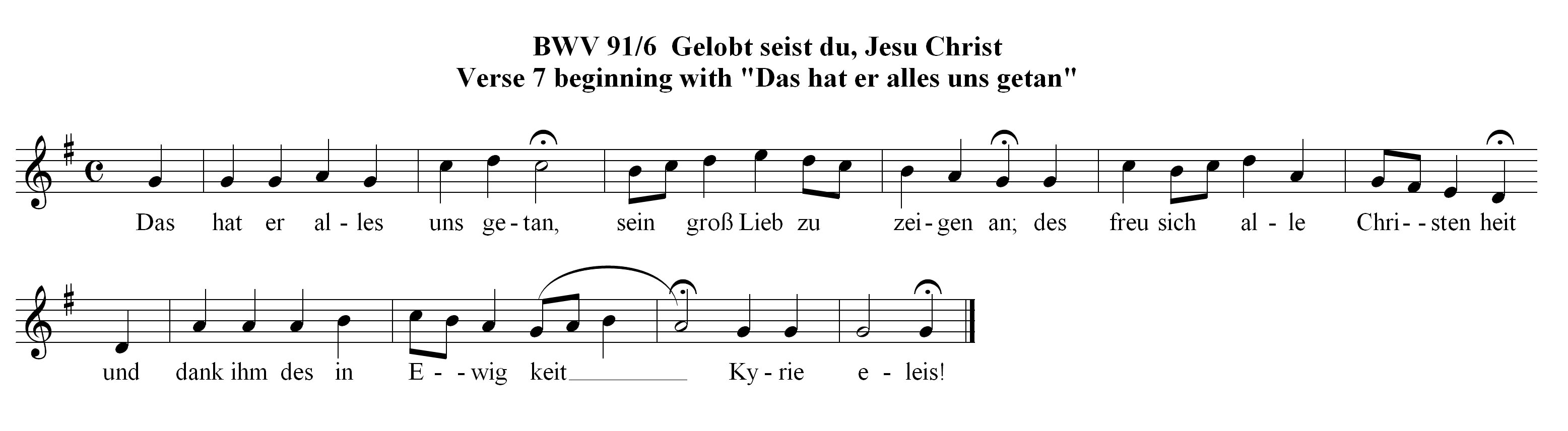
BWV 91 |
Mvt. 6 |
1724 |
53 |
109 |
51 |
130 |
A9:6 |
PDF | PDFch |
Mvt. 6 (MG) | Mvt. 6 (MG) ch [midi] | Mvt. 6 (Leusink) [ram |
|
6 |
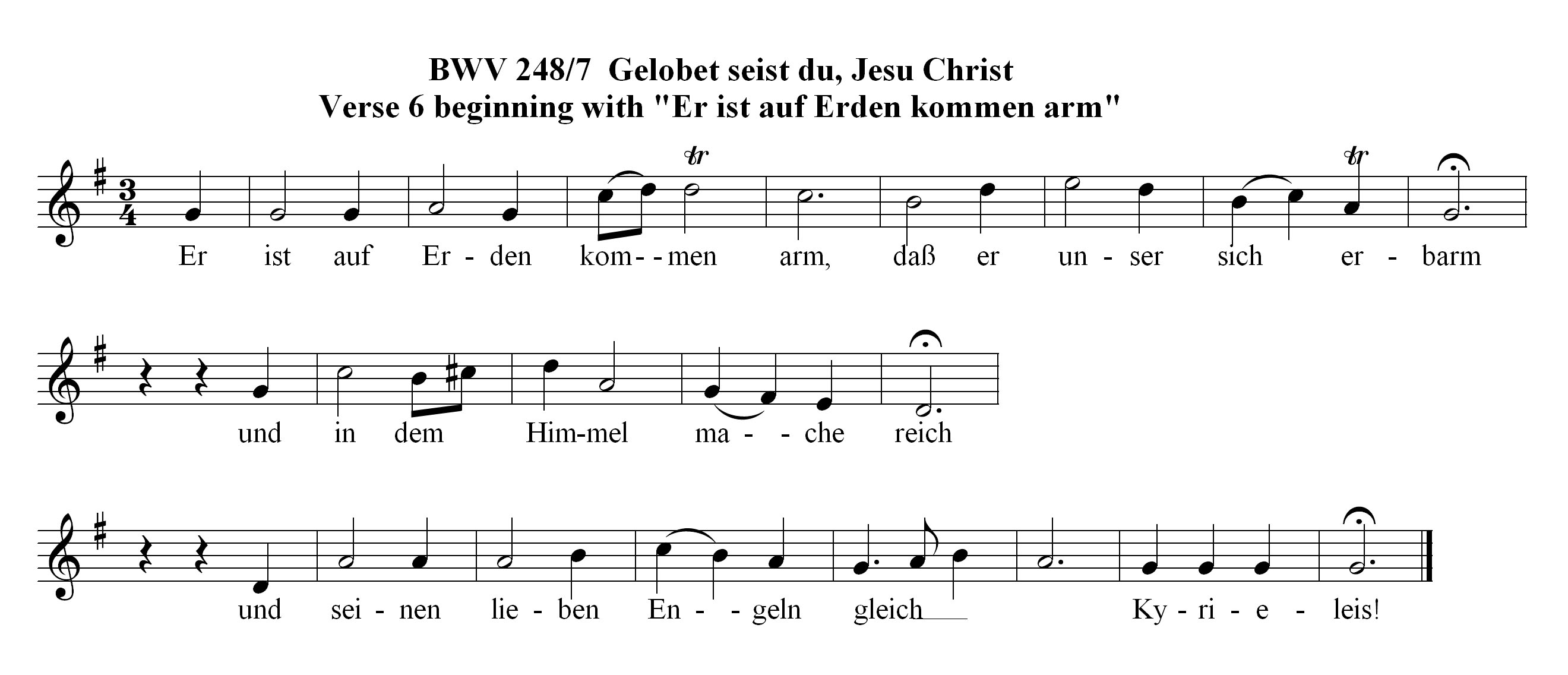
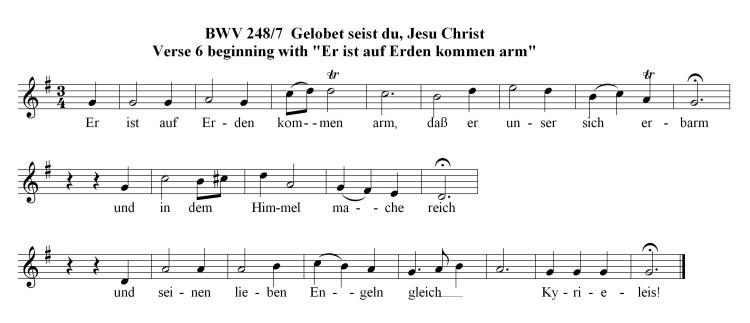
BWV 248 |
Mvt. 7 |
1734 |
- |
- |
- |
- |
D7:7 |
|
|
|
7 |
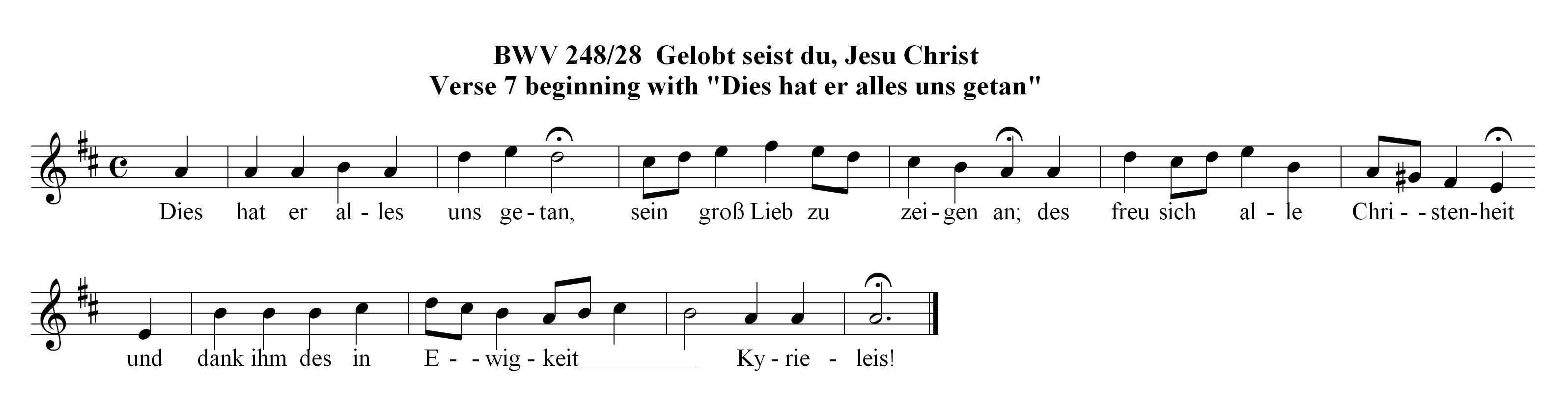
BWV 248 |
Mvt. 28 |
1734 |
- |
110 |
- |
123 |
D7:28 |
PDF |
Mvt. 28 (MG) [midi] |
|

|
|
|
|
|
|
|
|
|
|

|
| |
|
Untexted: |
|
Ver |
Work |
Mvt. |
Year |
Br |
RE |
KE |
Di |
BC |
Score |
Music Examples |
|
- |
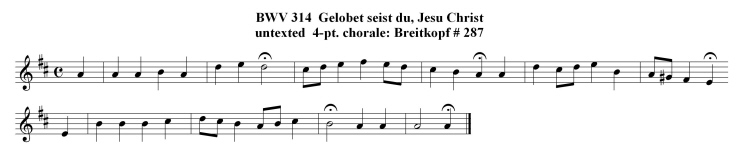
BWV 314 |
- |
? |
287 |
107 |
288 |
65 |
FC69.1 |
PDF |
Chorale (MG) [midi] |
|
- |
BWV 604 |
- |
1713/15 |
- |
- |
- |
- |
K33 |
|
|
|
- |
BWV 697 |
- |
1707/17 |
- |
- |
- |
- |
K147 |
|
|
|
- |
BWV 722(a) |
- |
1700/17 |
- |
- |
- |
- |
K114 |
|
|
|
- |
BWV 723 |
- |
|
- |
- |
- |
- |
- |
|
|
|
BWV 314: probably from a lost cantata.
BWV 604: Orgelbüchlein
BWV 723: not included in the NBA – Is currently listed by the Grove Music Online dictionary as definitely being a composition by Johann Michael Bach. Also see below. |
|
|
|

|
|

|
|

|
| |
|
Use of the Chorale Melody by other composers: |
|
Caspar Copus (mid 16th century):
Gelobet seist du, Jesu Christ [no further details about this version available] |
|
Christian Janszon Hollander (1510-1516 - 1568/1569):
Gelobet seist du, Jesu Christ for 5 voices taken from a printing dated 1570
Gelobet seist du Jesu Christ for 5 voices (1610) |
|
Johann Eccard (1553-1611):
Gelobet seist du, Jesu Christ, Chorale Motet for 5 voices, appeared in Geistliche Lieder auf den Choral (1597) |
|
Adam Gumpelzhaimer (1559-1625):
2 schöne Weihenacht Lieder, ... Gelobet seist du Jesu Christ ... Vom Himmel hoch, 4 St. . ... Item das alte Gelobet, Fit porta Christi u. alte Joseph, 5 St., Incerti autoris, (Augsburg, 1618) [a 5-pt. setting of Gelobet seist du, Jesu Christ] |
|
Andreas Raselius
[Raesel] (c1563-1602):
Gelobet seist du, Jesu Christ for 5 voices (1610) |
|
Melchior Schärer (1570-1602):
Gelobet seist du, Jesu Christ , A-Capella Motet for SAB |
|
Michael Praetorius (1571-1621):
In his Polyhymnia Panegyrica there is an item # 32 which is Gelobet seystu Jesu Christ and is listed for performance with 2, 3, 4, or 5 ‘chori’ [which means instrumental groups] and set for 8, 9, and up to 20 voices/vocal parts]
In his Polyhymnia Exercitatrix, there is a listing of a Gelobet Jesu Christ in 3 parts for 2, 4, and 6 voices. Praetorius explains that these compositions are particularly suitable for boys (‘and other musicians’) and are set according to the current Italian manner/style (Gabrieli, etc.). In his Polyhymnia X containing almost exclusively Latin motets, there is one composition with 8 vocal parts and 2 chori entitled: Gelobet seystu Jesu Christ
In his Syntagma musicum Volume III, p. 181, Praetorius writes regarding Gelobet seystu Jesu Christ and a few other chorales can also be sung without Ornament-Instrumenta [‘obbligato instruments’] using only the Concertat-Stimmen [‘solo voices’] with an organ or other Fundament-Instrumenten [‘instruments in the basso continuo group’] very distinctly and gracefully/delicately [“zierlich”] as it is appropriate and with a ‘pure’ [‘clean intonation’ and/or ‘without the use of embellishments’] voice. On p. 186, Praetorius suggests the Gelobet seistu Jesu Christ can be performed as follows: Have the singers and/or choirs (including the instrumentalist choirs) sing and/or play the first line of the verse Gelobet seist du, Jesu Christ, after which an instrumental ritornello is played. Then the entire musical group begins, once again, from the beginning to continue through the entire verse. Or, the ritornello can be inserted between the lines Das hat er alles uns gethan and the continuation of it in seine grosse Lieb zu zeigen an. |
|
Johann Hermann Schein (1586-1630):
Gelobet seist du, Jesu Christ, hymn for SATB [bc] (1627)
Gelobet seist du, Jesu Christ, Cantata for SST, bc (Opella nova, Part 1, No. 2) (1618) |
|
Samuel Scheidt (1587-1654):
Gelobet seist du, Jesu Christ for Soprano SSWV135
also SSWV 442 (2 versions above). See: Score
SSWV 282 Gelobet seist du, Jesu Christ (chorale), SATB, bc;
Gelobet seist du, Jesu Christ motet for 8 voices contained in Die Mottette vol. I, p. 153, Hänßler, Stuttgart |
|
Johann Heinrich Scheidemann (1595-1663):
Gelobet seist du, Jesu Christ, for organ |
|
Johannes Crüger (1598-1662):
Gelobet seist du, Jesu Christ for 4 voices, 2 obbligato instruments (violins), and continuo.
From the MGG1 [Bärenreiter, Kassel, 1986] Walter Blankenburg observes:
“Here it becomes clear that he [Crüger] basically no longer recognizes the church modes. The old chorale melodies undergo a complete transformation through the use of innumerable instances of ‘leading tones’ and become simply major and minor melodies [and not any particular church mode]. This process of transformation [of the old, church-mode melodies into major-minor ones] had already been started by the development of the ‘cantional’ style with Crüger pushing this change even more in this [Crüger’s] manner [of setting these chorale melodies].
“Hier zeigt es sich, daß er Kirchentonalität im Grunde nicht mehr kennt. Die alten Weisen werden durch zahllose Leittonbildungen als Dur- und Moll- Weisen völlig umgeprägt. Dieser bereits durch den Kantionalstil eingeleitete Umwandlungsprozeß wurde von Crüger auf diese Weise wesentlich weiter getrieben.”
|
|
Thomas Selle (1599-1663):
Gelobet seist du, Jesu Christ, motet for 4-voice choir & continuo, Op 3/5 |
|
Andreas Hammerschmidt (1611-1675):
Sonata on Gelobet Seist Du Jesu Christ for alto, 2 trumpets, 4 trombones & continuo
Gelobet seist du Jesus Christ, for voice, 2 trumpets, trombones & continuo (from Kirchen- und Tafel-musik) |
|
Matthias Weckmann (c1616 or1621-1674):
Gelobet seist du, Jesu Christ, Two Chorale Preludes for Organ
Gelobet seist du Jesu Christ, 2 variation cycles for keyboard
Regarding the latter, Alexander Silbiger in the Grove Music Online, Oxford University Press, 2005, acc. 12/22/05 states:
>>Closely rivalling these works in consummate craftsmanship and in range of form and expression are the nine sets of chorale variations for organ. The individual verses present, and often amplify, almost every variation technique practised by Weckmann's predecessors, from learned canonic cantus firmus settings (in Es ist das Heil and O lux beata trinitas) to extended echo fantasias (verse 2 of the first setting of Gelobet seist du). Their textures range from thic, six-voice imitative polyphony with double pedal (verse 7 of Es ist das Heil) to effusive soloistic figurations over sustained, sensuous backgrounds (verse 2 of Magnificat secundi toni). Es ist das Heil and O lux beata trinitas stand apart from the other sets for their monumental conceptions; each takes approximately half an hour to perform and the number of verses indicates that they could not have been intended for the usual liturgical alternatim practice. Davidsson (1991, p.14) suggests that they were played at Saturday Vespers, directly after the sermon.<<
|
|
Samuel Marckfelner (1621-1674 - Bohemia/Slovakia):
Gelobet seist du, Jesu Christ, for organ |
|
Peter Morhard [Mohrhardt, Mohrhart] (birth date unknown - 1685):
Gelobet seist du, Jesu Christ, Chorale Prelude for Organ
A German composer and organist. He is first heard of in 1662, when he became organist of the Michaeliskirche, Lüneburg; he held the post until his death and was succeeded in it by his eldest son, Friedrich. |
|
Johann Balthasar Erben (1626-1686):
Gelobet seist du, Jesu Christ, set for 5 [S, 2 A, T, B] voices, 2 violins, 3 instruments, violetta, bassoon, bc (in tablature) |
|
Constantin Christian Dedekind (1628-1715):
Gelobet Seist Du |
|
Dietrich Buxtehude (c1637-1707):
Gelobet seist du, Jesu Christ, Chorale prelude for organ in G major, BuxWV 188
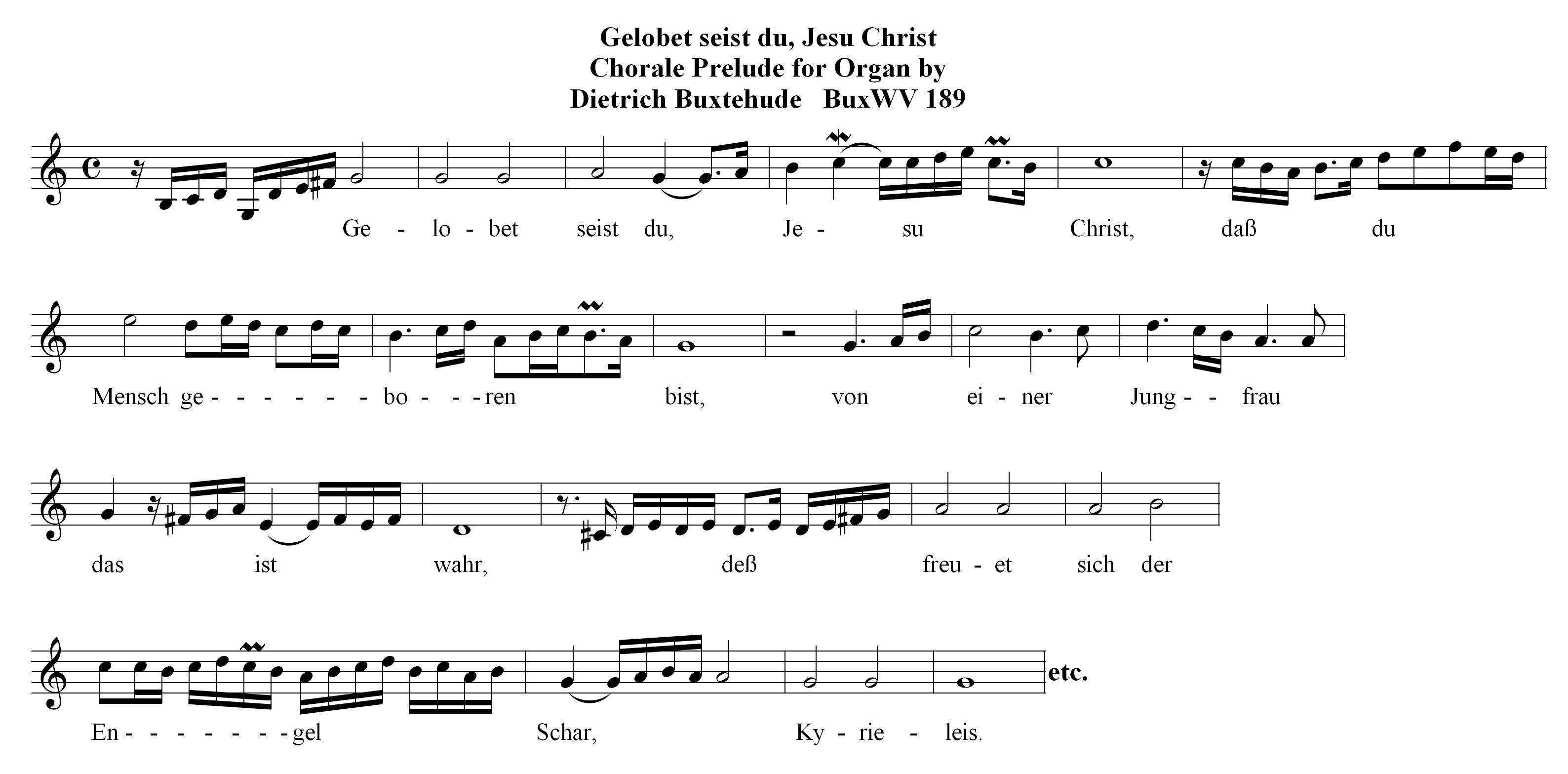
Gelobet seist du, Jesu Christ, Chorale prelude for organ in G major, BuxWV 189 |
|

|
|
Johann Friedrich Alberti (1642-1710):
Gelobet seist du, Jesu Christ, Chorale Prelude for Keyboard |
|
Johann Michael Bach (1648-1694):
Gelobet seist du, Jesu Christ, Chorale Prelude for Organ which used to be BWV 723 |
|
Johann Philipp Förtsch (1652-1732):
Fragments of a chorale cantata Gelobet seist du Jesu Christ |
|
Johann Pachelbel (1653-1706):
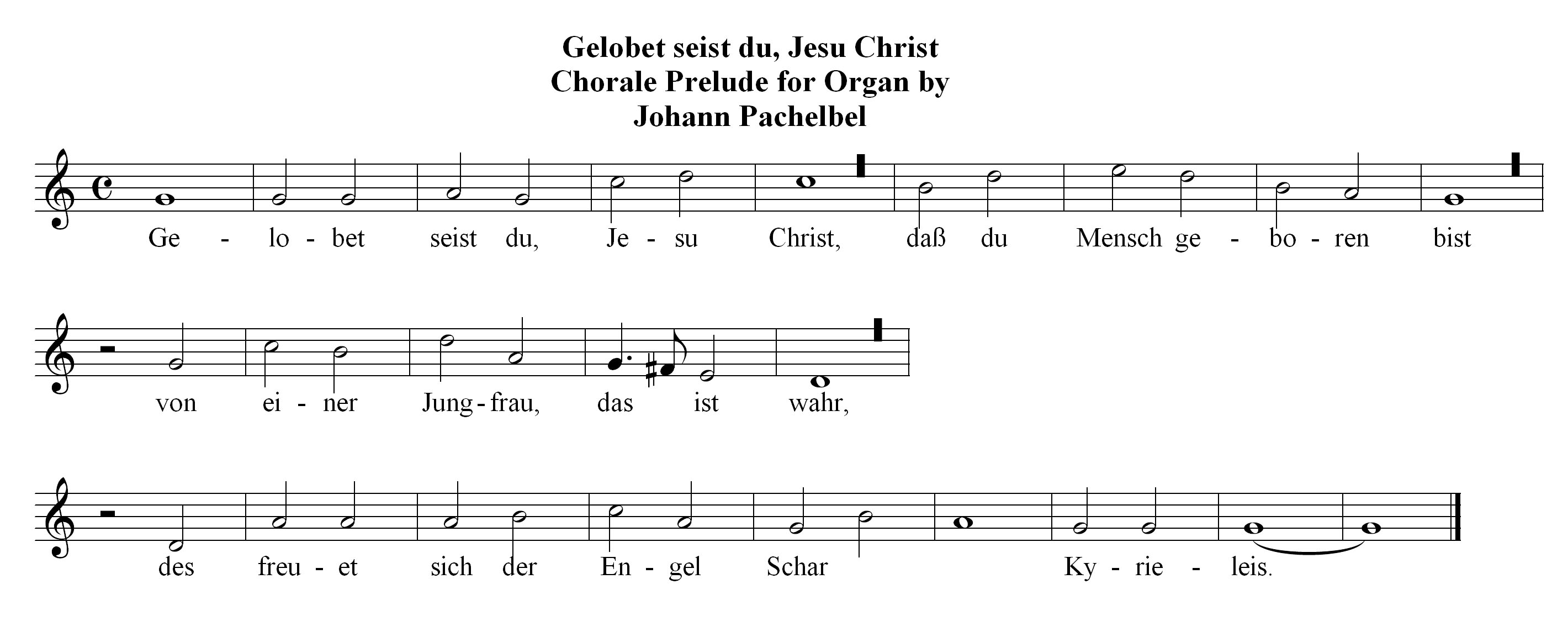
Gelobet seist du, Jesu Christ, Chorale Prelude for Organ. T. 38 |
|

|
|
Georg Böhm (1661-1733):
Gelobet seist du, Jesu Christ for clavier(?) a Chorale Partita
Gelobet seist du, Jesu Christ, Chorale Prelude for Organ |
|
Friedrich Wilhelm Zachow (1663-1712):
Gelobet seist du, Jesu Christ, Chorale Prelude for Organ |
|
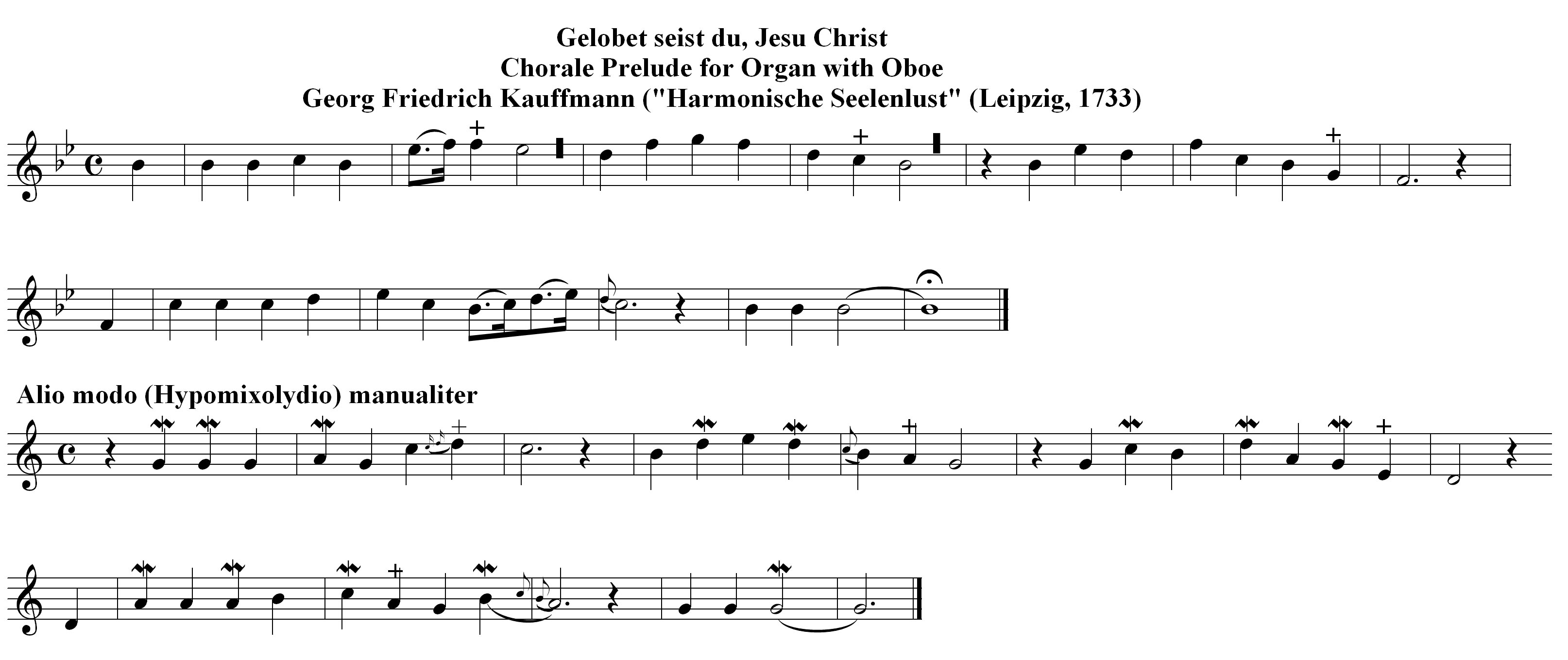
Georg Friedrich Kauffmann (1679-1735):
Gelobet seist du, Jesu Christ, Chorale Prelude in 2 versions: 1. for Oboe and Organ; 2. for Organ (manualiter) (1733) |
|

|
|
Georg Philipp Telemann (1681-1767):
Gelobet seist du, Jesus Christ (I) (Neumeister), sacred cantata for chorus, 2 oboes, strings & continuo, TWV 1:611 (1718)
Gelobet seist du, Jesus Christ (II) (Neumeister), sacred cantata for chorus, 2 oboes, strings & continuo, TWV 1:612 |
|
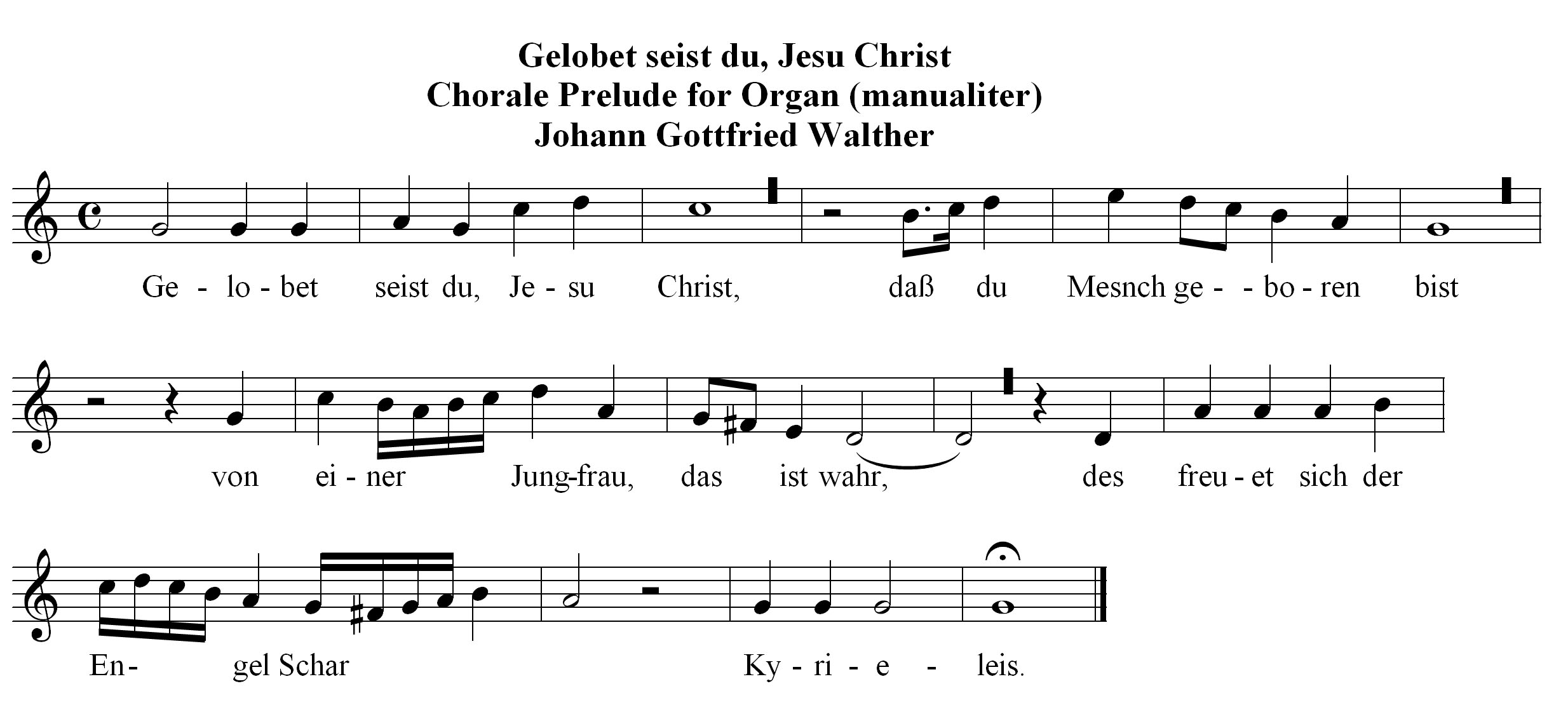
Johann Gottfried Walther (1684-1748):
Gelobet seist du, Jesu Christ, Chorale Prelude for Organ |
|

|
|
Gottfried August Homilius (1714-1785):
Gelobet seist du, Jesu Christ, Cantata
Gelobet Seist Du, Jesu Christ, Chorale for Organ |
|
Johann Christoph Altnikol (1720-1759):
Gelobet seist du, Jesu Christ, for organ |
|
Johann Philipp Kirnberger (1721-1783):
Gelobet seist du, Jesu Christ, Chorale prelude for organ |
|
Friedrich Zelle (1845-1927):
Gelobet seist du, Jesu Christ, Cantata |
|
Erhart Ermatinger (1900-1966):
Gelobet seist du Jesu Christ, Chorale Prelude for Organ, Op. 24, No. 1 |
|
Kurt Hessenberg (1908-1994):
Gelobet seist Du, Jesu Christ, Chorale Cantata for mixed chorus, 2 solo voices, organ and orchestra, Op. 9 (1935) |
|
Heino Schubert (1928- ):
Gelobet seist du, Jesu Christ, Cantata |
| |
|
Sources: NBA, vols. III/2.1 & 2.2 in particular [Bärenreiter, 1954 to present] and the BWV ("Bach Werke Verzeichnis") [Breitkopf & Härtel, 1998]
The PDF files of the Chorales were contributed by Margaret Greentree J.S. Bach Chorales
Software: Capella 2004 Software, version 5.1.
Prepared by Thomas Braatz & Aryeh Oron (December 2005, February 2010))
Thanks to contributors: Ian Hammond (February 2010) |
|
A debt of gratitude is owed to Ian Hammond, who has pointed out errors concerning the origin of this CM and has also supplied an important source, Johann Walter’s earliest representation of this CM, contained in a facsimile available from the Bavarian State Library. |
|
|